

Mother-of-five Ayan* with her son, Mohamed, who was treated for malnutrition at the Siinkadheer Health Facility, Mogadishu, which is operated by Concern. Photo: Adnan Mohamed/Concern Worldwide
A deadly combination of consecutive seasons of failed harvests, drought, floods, and conflict has resulted in a hunger crisis, with an estimated 6.5 million people deemed food insecure.
Nearly one-third of the population is experiencing high levels of acute food insecurity (IPC Phase 3 or above), including more than two million people in Emergency conditions (IPC Phase 4).
Alliance2015 member Concern Worldwide and the European Union have a longstanding partnership in Somalia. One of the programmes the EU supports is the Somali Cash Consortium (SCC), which is led by Concern and provides unconditional cash transfers that are delivered electronically via mobile phones and enable families to buy whatever they need most.
The SCC, which is primarily funded by the European Union and the Swiss Agency for Development and Cooperation (SDC), has been supporting displaced people with muti-purpose cash support since the Consortium began in 2018. €7.9 million was distributed to 30,520 households between April 2025 and May 2026 alone.
The Somali Cash Consortium is led by Concern and includes its fellow Alliance2015 member ACTED. Together with consortium members COOPI, DRC, NRC, SCI, and IMPACT Initiatives, they have a wide reach countrywide. This is increased further by linkages with other consortia and external partners.
“Somalia continues to face a protracted humanitarian crisis, driven by recurring climatic shocks, insecurity, displacement and rising food prices,” SCC Director Faith Tindimwebwa said.
“Multi-purpose cash assistance remains one of the most viable ways to provide dignified and prompt support, with its ability to reach populations wherever they are and transfer values that are adaptable to the market context.“
“This timely assistance enables affected families to cover essential needs such as food, water, healthcare and shelter, while supporting local markets.”
The EU and the SDC have confirmed that funding for this project will continue – with the EU providing €9 million in 2026/2027, while the SDC will give an additional €6.1 million over a four-year partnership with the SCC.
The SCC will prioritise those who are highly food insecure and the most vulnerable in target communities in line with vulnerability-based targeting methodologies, including female-headed households, minority clans, older people, people with disabilities, newly displaced persons, pregnant and breastfeeding women and malnourished children. The SCC is working across South Central Somalia, Somaliland, and Puntland, focusing on hard-to-reach and underserved high-severity areas.
The commitment to continued funding is particularly welcome at a time when drastic cuts to humanitarian aid globally have been devastating, and it is clear that the SCC programme has a life-changing impact.
One of the people who has received SCC support is Ayan*, whose family lived in a village in the Bay Region, raising goats and farming the land.
She recalled: “I used to grow peas and beans. We had food, we had animals, and we survived on what we made.”
But then: Drought.
“At first, it was small,” Ayan (26) says. “The rain didn’t come on time. But then it got worse. The land dried up, and the animals started dying.”
One by one, her goats perished. Her farmland dried into cracked dirt. She made the decision to leave. “I sold my last two goats. I bought a place on a truck to Mogadishu.”
The truck was originally used for transporting livestock, but in the Somalia of today, it is people that are moving in mass.
“Around 20 of us were packed in there. It was so tight; we could barely move.”
After three days, Ayan and her five children – the youngest of whom was just a year old – made it to a displacement camp in Mogadishu.
“We had nothing,” she says. “No food, no water, no shelter. We slept on the ground.”
“I can’t even describe it. It was just one bad day after another. My children cried from hunger. There were nights when we went to sleep without eating anything at all.”
Ayan had left her home in hope of saving her children. Now, their lives were hanging in the balance.
One morning, Ayan saw an outreach group from Concern walking around the camp, talking to people. “I heard them talking about helping malnourished children and providing free medical care. They were also giving cash to people in need.”
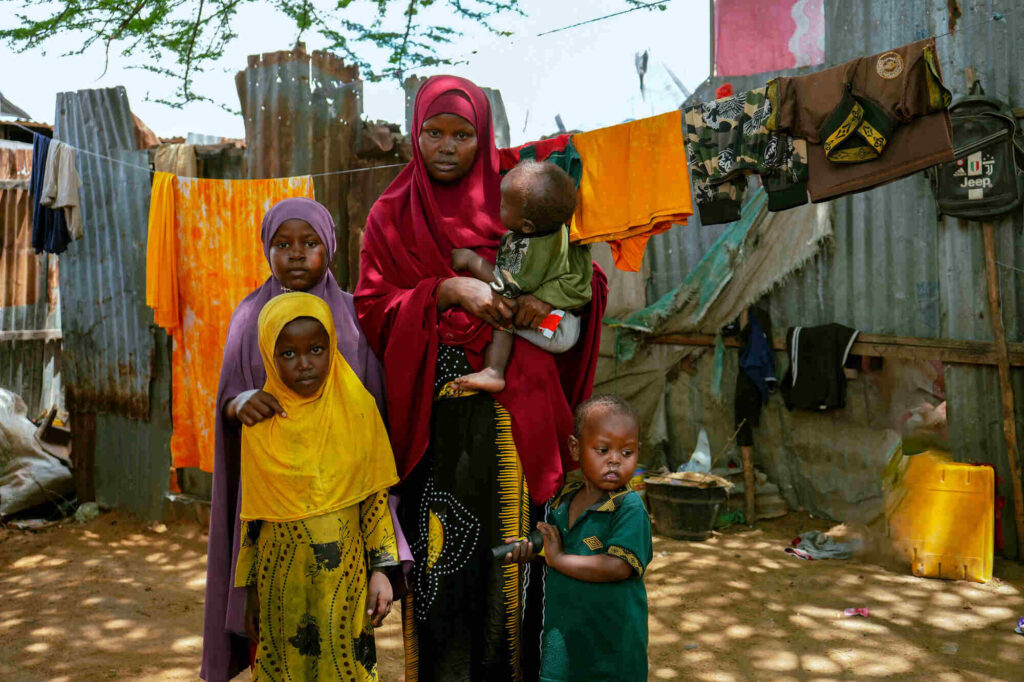
The group assessed Ayan’s children. Her youngest child, Mohamed*, was identified as malnourished. He was referred to the Siinkadheer Health Facility – which is operated by Concern, with funding from the EU,Irish Aid Chronic Crises Stream, the World Food Programme and UNICEF- for urgent treatment.
After receiving supplementary feeding, Mohamed recovered, but as conditions of extreme poverty persist outside the facility gates, health workers often see children returning, again malnourished.
A few weeks later, with one text message, Ayan received a lifeline.
She recalls: “I was sweeping the floor when I got a message on my phone, I checked it, and it said I had received $USD 180.”
“With that money, I could pay for my children’s madrasa [schooling]. I have three children in madrasa, and it costs $10 per month for each child. I also bought food for them. I hadn’t been able to afford fresh vegetables in so long. They were so happy to eat peas and maize again. It reminded me of home.”
Ayan still lives in extreme poverty but the cash has given her breathing room. She has space to plan, to dream.
She says: “I want my children to finish their studies and live in a good home. This little bush we’re living in now is not what I want for them. In the future, I want to stand on my own feet and open a small shop. I don’t want to depend on anyone anymore. I want to be strong for my children.”
“I believe we can make it. My children deserve better, and I will fight for them.”
*Names have been changed.
Credits: Concern Worldwide
