

International Day for Disaster Risk Reduction – 13 October
On the International Day for Disaster Risk Reduction, Ibrahim Adoum’s story highlights how local action can help communities reduce their exposure to natural hazards and protect their livelihoods. In Alindao, Central African Republic, farmers are working together to address the risk of flooding to their rice fields by digging a drainage channel to redirect water away from cultivated areas. Their efforts illustrate the importance of community-led initiatives in protecting agricultural production and strengthening food security.
“Ayo mingui mama, legué ti Alindao oooo” — “The road to Alindao is long.”
In Alindao, in southeastern Central African Republic, this popular song reflects a daily reality. The town lies more than 500 kilometers from the capital Bangui, and the journey can take nearly two days by four-wheel-drive vehicle, often over difficult roads through Sibut and Bambari.
Alongside cassava, rice also plays an important role in diets across the Central African Republic and is regularly consumed by many households. In Alindao, however, distance and poor road conditions affect food supplies, and much of the rice consumed locally still comes from outside the area, including imports from Cameroon, Chad and Sudan. Transport costs push prices higher: imported rice can sell for about CFA 1,000 (about 1,52 Euro) per kilogram, compared with roughly CFA 650 (about 0,99 Euro) for locally produced rice. Strengthening local rice production can therefore help improve food security while supporting rural livelihoods and reducing dependence on more costly external supplies.
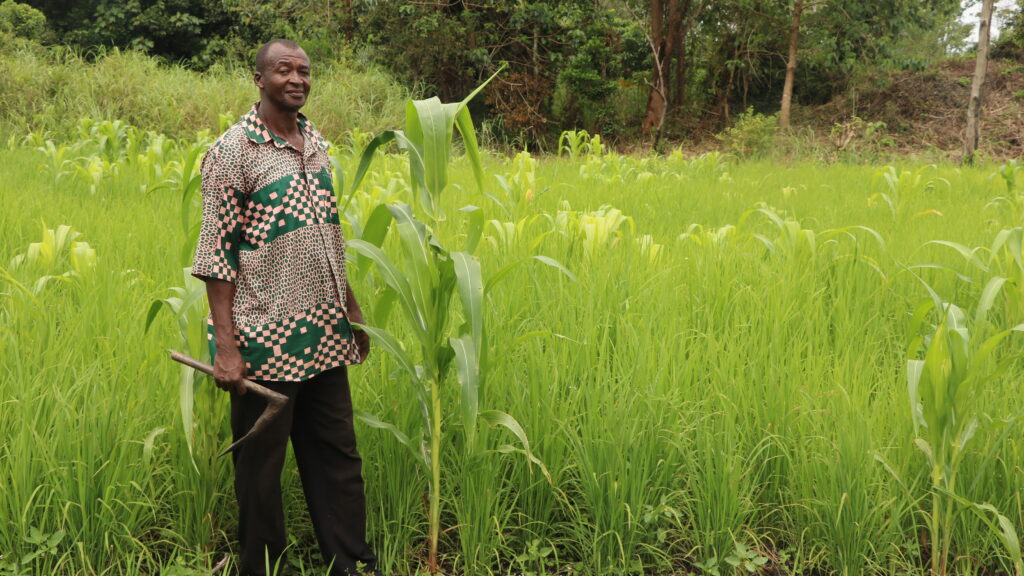
For 49-year-old farmer Ibrahim Adoum, president of the “Les Multiplicateurs de Semences” (translates to “Seed Multipliers”) agricultural group, this challenge is also an opportunity. His goal is straightforward: produce more high-quality rice locally so that families in Alindao can increasingly eat what is grown in their own community.
The daily walk to the fields
Early each morning, Ibrahim and other group members head to their fields, located more than eight kilometers outside Alindao along the road to Bambari. They walk there carrying their tools. Rice is their main crop, alongside several others.
“We want to produce more rice so that people can eat rice grown here,” Ibrahim says.
Agriculture, livestock, and small-scale trade remain the main sources of income in Alindao. For local farmers, increasing production can therefore strengthen livelihoods while contributing to the community’s food security.
Better seed and stronger skills
Ibrahim’s group is one of ten seed multiplication groups supported through the Yaka Ti Kekereké project. Implemented by Alliance2015 member Welthungerhilfe (WHH) in collaboration with Concern Worldwide and Tearfund, with funding from the European Union, the Integrated Support for Agricultural Recovery and Food Security in the Central African Republic project has been active in nine prefectures since 2023.
The project supports recovery in the agriculture and livestock sector by promoting more sustainable production and stronger agricultural value chains.
In Alindao, group members received G4 seed 1for groundnuts, maize, and paddy rice for multiplication. G4 seeds are fourth-generation seeds produced through a controlled multiplication process from higher-grade seed material. They are intended for further multiplication by seed producers to increase the availability of quality seed for subsequent farming seasons. They also received agricultural tools and post-harvest equipment. The material support was combined with training seed production techniques, post-harvest practices, the preparation and use of biopesticides, and group management.
For Ibrahim, the support is helping the group strengthen its capacity while gradually increasing the availability of quality seed within the community.
An encouraging harvest — and continuing risks
During the last agricultural season, the group harvested 164 bags of rice. At an estimated 60 kilograms per bag, that is approximately 9.8 metric tons. In the next season, members hope to nearly double their production.
But producing more is only part of the challenge. Crops also need to be protected. During the rainy season, the Bangui-Kété River can overflow and flood rice fields. To reduce the risk, group members have begun digging a large drainage channel together to redirect water away from cultivated areas.
The effort shows how collective organization can help farmers develop practical solutions to the challenges they face.
From the field to the table
Another obstacle comes after harvest. Paddy rice must be milled before it can be eaten, yet producers do not have suitable processing equipment nearby. The group hopes to obtain a rice mill so it can process its harvest directly in Alindao.
Local processing would help farmers add value to their production, reduce dependence on services outside the area, and potentially generate more income. For Ibrahim, the aim is to shorten the distance between the field and the family table. Ibrahim is married to three women and is the father of 13 children, making a reliable harvest particularly important for his household.
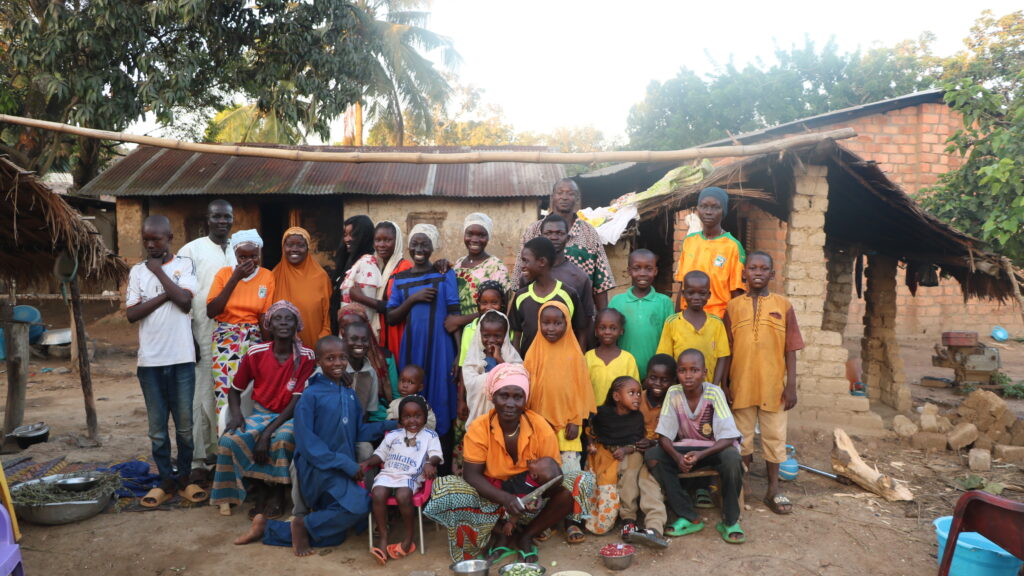
Credit: WHH/Bienvenu Elie GBELO
Farming for family and the future
After more than 22 years in agriculture, farming remains Ibrahim’s primary source of income. For the past two years, he has also participated in a Village Savings and Loan Association, saving CFA 40,000 each month (about 61 Euro). Those savings have already helped him invest in a small cassava-grinding machine, now operated by one of his children and providing an additional source of household income.
His story is also shaped by years of conflict, when insecurity prevented many farmers from reaching their fields. Ibrahim gradually resumed farming in 2022.
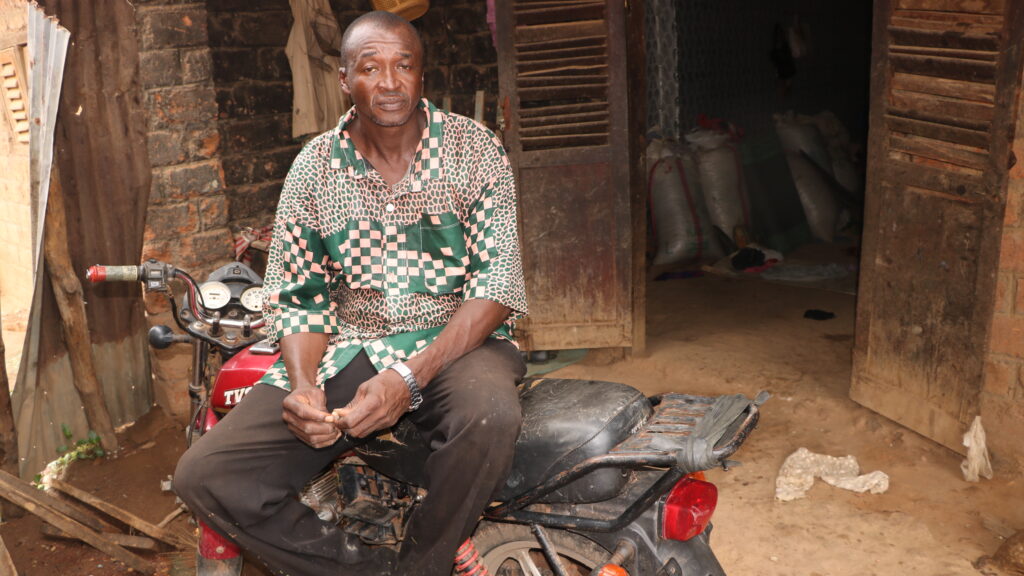
Credit: Credit: WHH/Bienvenu Elie GBELO
Today, he is looking ahead. He hopes his group can acquire a rice mill, oxen, and plows to cultivate larger areas and increase production.
The road in Alindao remains demanding — both literally and for farmers working to rebuild their livelihoods. Yet Ibrahim and the members of “Les Multiplicateurs de Semences” share a clear vision: producing more, protecting their harvests, and processing rice locally can strengthen farmers’ incomes and put more quality local rice on the tables of families in their community.
Article by: Welthungerhilfe
