

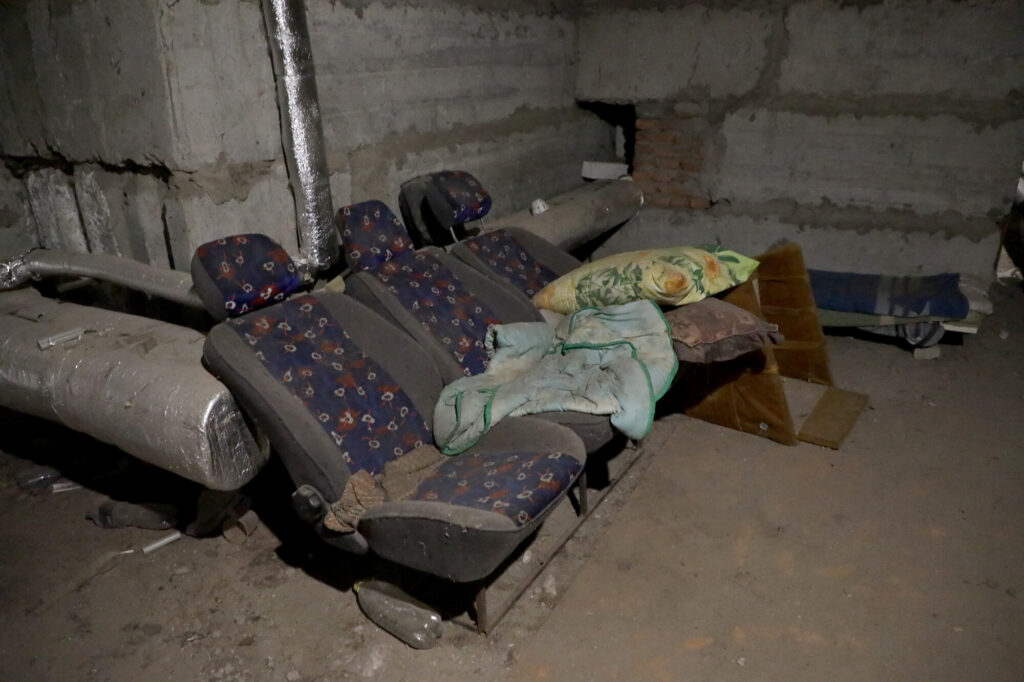
The basement of a building in Izium, Kharkiv. Community members lived in this basement for four months at the start of the conflict. Now, with a cash transfer from JERU, they are refurnishing the basement into a shelter. Photo: Jon Hozier-Byrne/Concern Worldwide
A bridge in two halves marked our arrival into Izium. Its jagged ruins emblazoned with the letters “UKRAINE” in colourful script.
Our driver points to what looked like two ruined buildings up ahead. As we drew closer it became clear that it was one, only now it boasted a 30-foot chasm down the middle. It was previously a school.
The remainder of the town had not fared much better. Abandoned homes line the streets. Their broken windows offer little defence from the falling snow, not that there is anyone inside to protect anymore.
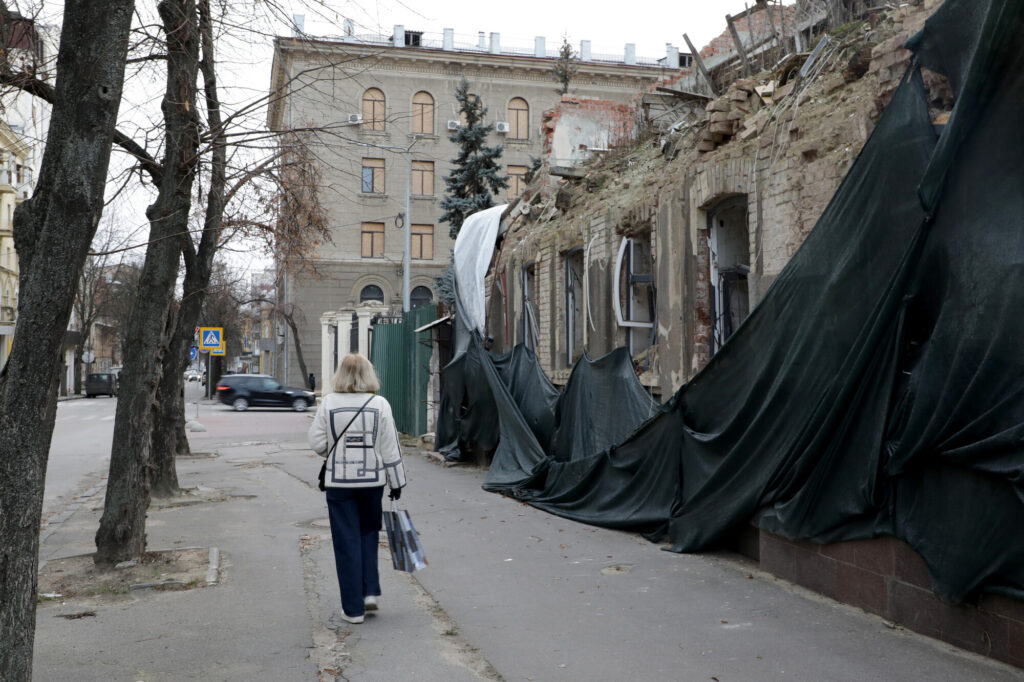
Izium, in eastern Ukraine, is one of many areas referred to as ‘de-occupied’ territory having been under Russian control between March and September of 2022 – but it feels empty.
Before the conflict this town was home to almost 50,000 people – now, that number has halved. The front line in the current conflict is just 40km away.
Hollowed out buildings with boarded-up windows were interspersed with coffee shops – exclusively coffee shops. Before I could dismiss this as a mirage driven by caffeine withdrawal, our driver, Sasha, confirmed my observations. With the frontline so close, soldiers retreat here to enjoy coffee, sushi, pizza or shawarma. These businesses spring up quickly and are just as quick to leave when the front line shifts again.
At a local community shelter, the increasingly familiar sound of the air raid siren reverberated through the empty street. During the previous five days in Kharkiv, I had noticed an attitude of nonchalance around these alarms, an apathy born from four years of accumulated frustration. Which is why I was taken aback by Sasha, our driver remarking “when you hear the air raid alarm here – it is not good”.
The small figure of Liudmyla appeared in the distance to urge us inside with grandmotherly admonishment prompted either by the current threat or the cold. A woman in her early 70s, Liudmyla had a radiant smile, complimented by the sparkly butterfly on her woolly hat.
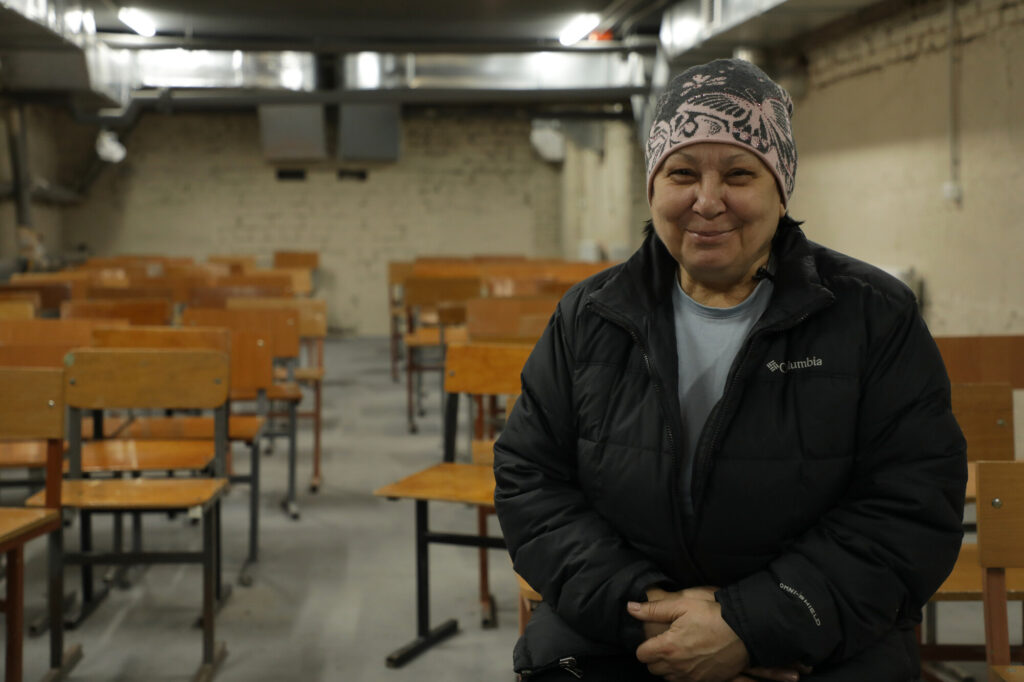
She led us down a flight of stairs into an underground labyrinth of white-washed chambers and launched straight into a grand tour. As we went from chamber to chamber Liudmyla proudly spoke about the renovations that had been completed with grants from both the state and the Joint Emergency Response in Ukraine (JERU) — a collaboration between Alliance2015 members Concern Worldwide and Welthungerhilfe.
The floors had been levelled with concrete and painted to minimise dust. The plan for the remaining JERU funding is to set up a children’s playroom and purchase pull-out beds for older residents in the community who had taken to gathering in the shelter even when the air raid alert was not active.
In 2022 when the residents had spent a lot of time in the shelter, a woman had broken her leg rushing to get inside. One significantly larger chamber had rows of chairs giving the air of a school assembly hall. The chairs, Liudmyla told us, had been recovered from the school after the bombing and had most recently been used in a children’s event.
It became clear that this shelter had become so much more than a safe place to hide – it was a workshop for rebuilding a community that had been decimated and dispersed and finally found its way home.
Up an unmarked road so bumpy it had my teeth rattling in my skull, a serious looking man in his forties stood by the gate. “Hello!” he boomed as we approached stretching out his arms for a hug. “Zelenskyi …..Volodymyr” he said breaking out into a cheeky grin that acknowledged the years of jokes he has no doubt endured by his name.
A nearby courtyard housed two ambulances. Volodymyr is the head of the volunteer group ‘Right Direct’ who carry out civilian evacuations from areas close to the front lines for people who are bedridden or disabled.
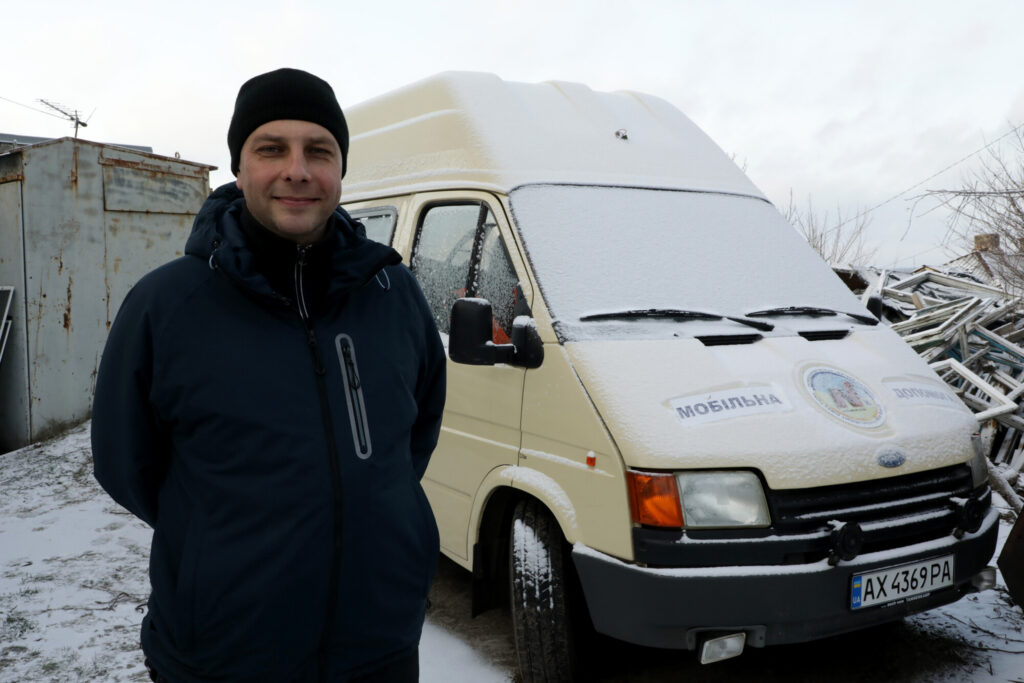
Since 2022, he has taken on the task of convincing people to leave their homes in ‘mandatory evacuation’ areas and facilitating their escape – an often dangerous task.
Relatives across the country will regularly contact his organisation with pleading requests to evacuate elderly relatives. Volodomir’s ambulance is specifically designed to transport bedridden and low-mobility people, equipped with a chair lift, and soon to be adapted to facilitate wheelchair access.
Among those he has evacuated were his son, 17 at the time, and his parents, both in their 70s.
In 2023 he himself suffered a heart attack – “I am disabled myself” he puts it, “I have a stent in my heart”. When asked whether he ever considered stopping this dangerous work, Volodymir gave a surprising answer: “I read a book, I forget the name of it – by a psychologist who survived Auschwitz. He spoke of the type of people that survive tragedy – it is not those who believe hardship will never end and it is not those that believe it will end tomorrow. Rather it is those that focus on what must be done right now and only on that. This is the approach I take”.
Our final stop in Izium was another shelter. We were led by two older women downstairs into a dark chamber lit by a single exposed lightbulb. A construction worker stood on a chair at one end, fixing a cistern to the wall, while a ginger and white cat drank from a water-filled paint dish.
Knee-high pipes, one foot wide, spanned the entryway into the remainder of the shelter, which remained unlit. A torch-lit walk through the labyrinth of chambers with Tetiana, a resident of the upstairs apartment building, revealed mementos of the last few years. Broken bedframes and mattresses are sunken into the sandy ground lined the walls in haphazard configurations.
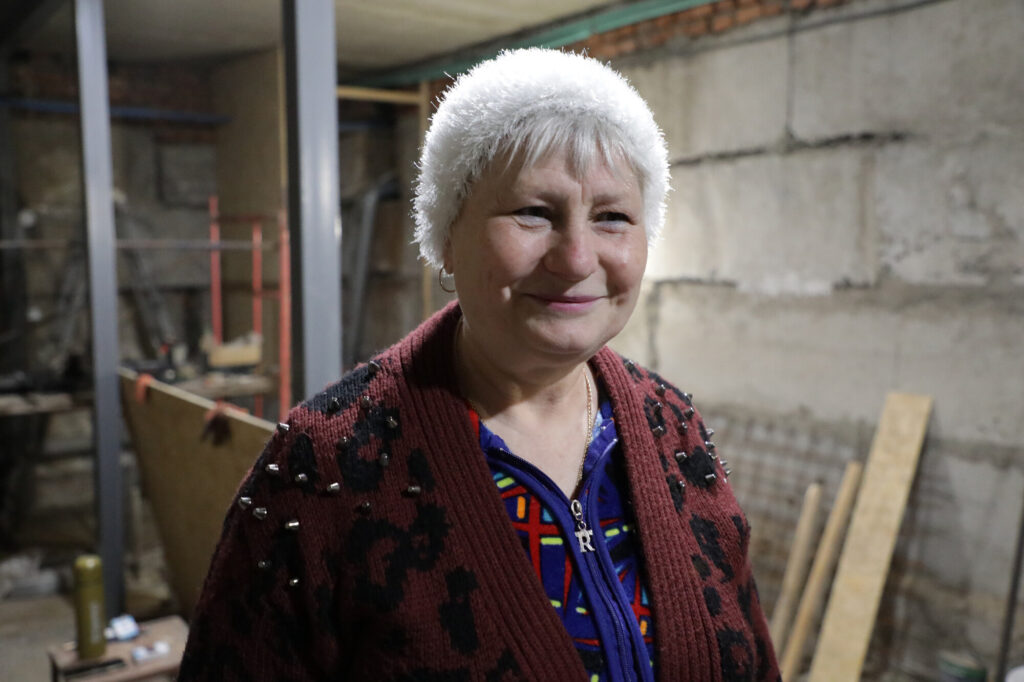
Over 100 residents had spent more than two months here, from the end of February 2022 until the start of May, many of them elderly and requiring care. There had been no toilet facilities and no electricity.
While these Izium residents expressed hope to never have to use this place for protection ever again, they are preparing as best they can with the help of a JERU grant to make the space more comfortable.
We drove away from Izium as the sun was setting. A town that had seemed barren at first, even during our short stay, had revealed stories of incomparable bravery and resilience lying just below its ruined façade.
Author: Jenny Gillen, Overseas Information Officer, Concern Worldwide
