

Ayuda en Acción, member of Alliance2015, believes that environmental challenges can become powerful opportunities for people and communities. That is why we are implementing the Bamagreen Project in Mali, an innovative circular economy initiative in West Africa co-led with adaPETation (IMG Group) and supported by the Spanish Agency for International Development Cooperation (AECID).
The project demonstrates how environmental protection and inclusive economic development can go hand in hand. By tackling plastic pollution, Bamagreen is helping build stronger, more resilient communities while creating sustainable livelihoods for vulnerable populations, including displaced people living in Bamako and the Ségou region.
Innovative Recycling Technology for Local Impact
At the heart of Bamagreen is an advanced recycling technology adapted to local conditions and provided by IMG Group, which brings extensive experience in plastic recycling through its global Plastic2Prosperity initiative.
The project combines semi-industrial equipment and scalable modular systems capable of processing up to 80 tonnes of plastic waste per month. Rather than simply collecting waste, Bamagreen closes the circular economy loop by transforming discarded plastics into certified materials for construction and electrification, as well as recycled plastic flakes that can be reintroduced into production chains.
This approach significantly reduces local pollution and carbon emissions while contributing to greater resource efficiency and reducing dependence on imported materials.
Creating Opportunities for Women and Young People
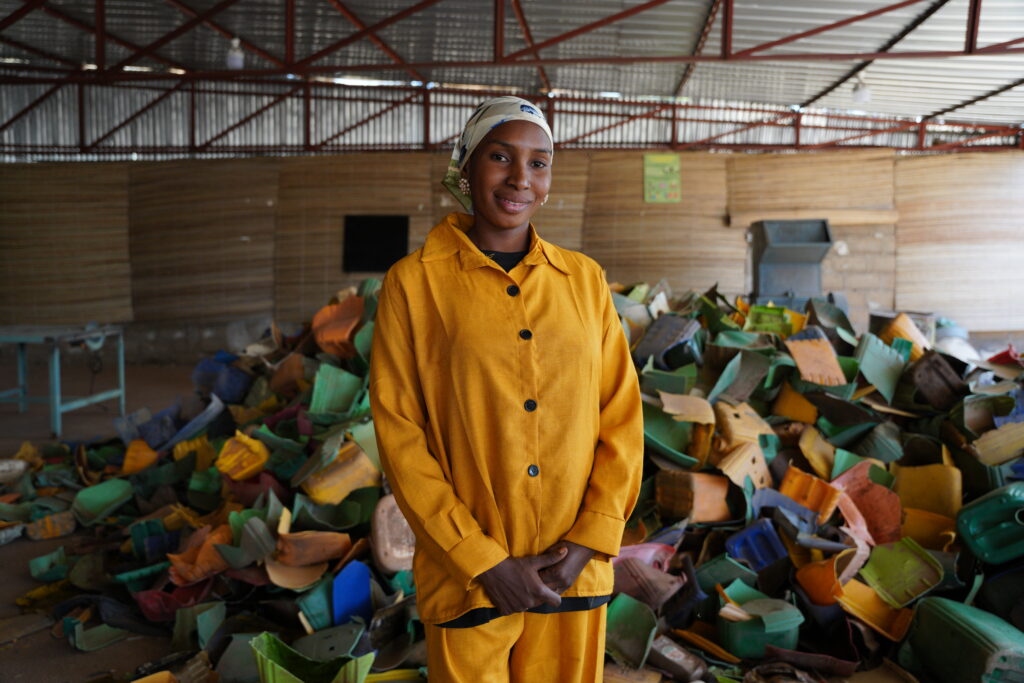
Fatimata Nanogo was just a child when she fled Ansongo in northern Mali with her siblings. Conflict forced them to move to Bamako, where she was given the opportunity to attend university and study Pharmacy, a degree she is still completing. Now 21, she strongly believes in the importance of growing some of the food she consumes.
“Thanks to Bamagreen, I have learned so much about environmental education. I now collect plastic waste at home and, at the same time, contribute to my family’s income. To me, it used to be nothing more than rubbish. Now I understand its value as an economic resource,” she explains.
Bamagreen’s greatest strength lies in its people-centred approach. Women and young people from peri-urban areas of Bamako are not only beneficiaries but key actors driving change in their communities.
During this phase, the project aims to:
- Recover and recycle more than 960 tonnes of plastic waste per year.
- Create 150 direct green jobs.
- Provide technical training in recycling and circular production to 150 people.
- Plant 50,000 trees to support environmental restoration and climate resilience.
Overall, the initiative is expected to generate a direct positive impact on 8,500 people and benefit more than 28,300 individuals indirectly across the target areas.
As Marta Tietz Laranjinha, Regional Director for Africa at Ayuda en Acción, highlights:
“Bamagreen shows that environmental challenges can be transformed into opportunities. By promoting decent employment, strengthening local capacities and supporting community-led solutions, especially for women and young people, the project is building a circular economy model with strong potential for replication across other African contexts.”
A Multi-Stakeholder Approach for Sustainable Development
Long-term transformation requires collaboration. Bamagreen brings together civil society organisations, private-sector partners, social enterprises, local authorities and public technical services to strengthen the entire recycling value chain.
The project supports:
- Improved waste collection, processing and commercialisation systems.
- Technical training and green employment opportunities.
- Reforestation and environmental awareness activities.
- Local innovation and knowledge-sharing mechanisms that strengthen community ownership and sustainability.
Through this integrated approach, Bamagreen contributes to several Sustainable Development Goals (SDGs), including:
- SDG 12: Responsible Consumption and Production.
- SDG 13: Climate Action.
- SDG 8: Decent Work and Economic Growth.
- SDG 4: Quality Education and Skills Development.
- SDG 5: Gender Equality.
- SDG 10: Reduced Inequalities.
Bamagreen demonstrates that a different model of sustainable development is possible, one that protects the environment while creating economic opportunities and ensuring that no one is left behind.
Article by Ayuda en Acción
